
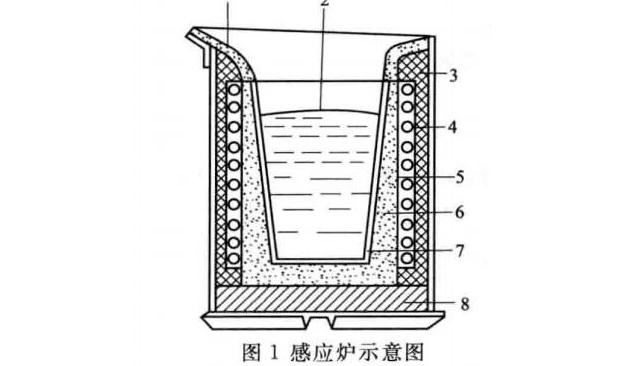
Induction furnaces are broadly categorized into core-type and coreless-type based on their construction. While core-type induction furnaces are primarily used for melting non-ferrous metals and their alloys, coreless induction furnaces are specifically designed for melting ferrous metals and alloys. They are particularly suitable for producing high-grade premium alloy steels and special alloys. This article focuses exclusively on coreless induction furnaces.
Based on the frequency of the input current, induction furnaces are classified into high-frequency (above 10,000 Hz, using vacuum tube generators), medium-frequency (500–10,000 Hz, using motor-generator sets), and line-frequency (power frequency) types.
Advantages and Disadvantages of Induction Furnace Steelmaking
Advantages
Compared to other steelmaking methods, induction furnace steelmaking offers several distinct advantages:
- No Carbon Pickup: It does not use carbon electrodes, preventing carbon pickup during melting. This makes it ideal for producing ultra-low carbon steels and alloys.
- Low Gas Content: The absence of an electric arc prevents the dissociation of gases in high-temperature zones, resulting in steel with lower gas content.
- Precise Temperature Control: Power and temperature can be easily adjusted over a wide range, allowing for accurate control of the required metal temperature.
- Electromagnetic Stirring: The electromagnetic stirring effect within the crucible accelerates metallurgical reactions between the molten steel and slag. It also promotes the removal of non-metallic inclusions and gases while ensuring uniform temperature and chemical composition.
- High Alloy Recovery Rate: Easily oxidized alloying elements can be added after proper deoxidation. The small unit surface area of the molten pool minimizes alloy burn-off, leading to high recovery rates.
- Flexible Atmosphere Control: Melting can be conducted under vacuum or in beneficial protective atmospheres to meet specific quality requirements.
Disadvantages
Despite its benefits, induction furnace steelmaking has certain limitations:
- Low Slag Temperature: Slag cannot be heated directly by induction; it relies solely on heat transfer from the molten steel. This results in a lower slag temperature, which is unfavorable for slag-metal interfacial reactions.
- Shorter Lining Lifespan: The thin crucible walls are subjected to continuous stirring, flushing, and erosion from both the molten metal and slag. Combined with significant thermal gradients, the refractory lining typically lasts for only a few dozen heats.
Refractory Lining Selection and Melting Process
1. Refractory Lining Selection
The choice of refractory lining must be matched to the specific steel grade being melted. Certain steel grades can only be produced in basic furnaces. For instance, melting high-manganese steels in an acidic furnace causes MnO to combine with SiO2 in the lining, forming low-melting-point silicates that rapidly degrade the refractory. Similarly, steels with high aluminum and titanium content will reduce the silica in the lining, causing severe damage and making composition control difficult. Additionally, high-chromium-nickel steels melted in acidic furnaces tend to have more silica inclusions; therefore, basic linings are highly recommended for these alloys.
2. Raw Materials (Charge)
Induction furnace melting is essentially a remelting process. Oxidative refining is rarely used because the low slag temperature limits desulfurization and dephosphorization capabilities, and the short melting time does not allow for composition control via furnace-side analysis. Consequently, raw material requirements are extremely strict:
- Purity: Sulfur and phosphorus levels must be as low as possible, ideally 0.005%–0.01% below the specification minimum.
- Accuracy: The weight and chemical composition of all charge materials, including ferroalloys, must be precisely known to control the final steel composition through calculation.
- Cleanliness: Charge materials must be clean, dry, and rust-free, especially for gas-sensitive alloys like nickel-based superalloys. Both charge and slag materials must be pre-baked before use.
- Size: The chunk size of the charge must be appropriate to ensure high packing density. Excessively fine materials increase inter-particle contact area, while overly large pieces reduce the bulk density of the charge column. Both scenarios increase the electrical resistance of the charge.
3. Charging and Melting
Before charging, residual steel and slag must be cleared, and the lining inspected for damage. Severely damaged areas, which often appear darkened due to rapid cooling, must be repaired. Repair materials should have a smaller particle size and slightly more binder than the original ramming material. For large furnaces with severe damage, an iron mold can be hoisted in to facilitate patching and ramming.
Since the molten steel cools rapidly after tapping, charging must be done quickly, preferably using a charging bucket. To accelerate melting, materials should be distributed according to the furnace's temperature profile. Due to the skin effect, the peripheral surface of the charge near the crucible wall is a high-temperature zone. The bottom and center have poorer heat dissipation and form a relatively high-temperature zone, while the top experiences high heat loss and low magnetic flux, making it a low-temperature zone.
To form slag early, approximately 1% of the charge weight in slag-forming materials can be added to the furnace bottom before charging (e.g., lime and fluorspar for basic linings, or crushed glass for acidic linings).
Melting begins with low power due to initial mismatches in line inductance and capacitance. Once the current stabilizes, full-load power should be applied. Capacitance must be continuously adjusted during melting to maintain a high power factor. After complete melting, the steel is heated to the target temperature, and power is reduced as required. Melting time must be carefully controlled; too short a time causes electrical matching difficulties, while too long a time increases unnecessary heat losses.
Operators must promptly address "bridging," which occurs when improper charging or rusty materials cause the charge to stick together. Bridging prevents the lower molten steel from contacting the solid charge, leading to overheating, lining damage, and excessive gas absorption. Due to electromagnetic stirring, the molten steel rises in the center, pushing slag toward the crucible edges where it may stick to the walls; therefore, slag materials must be replenished as needed during melting.
4. Refining and Deoxidation
Deoxidation is a critical task in induction furnace steelmaking. To achieve good results, an appropriate slag must be selected. Because slag temperature is inherently low, slags with low melting points and good fluidity are preferred. A common basic slag consists of 70% lime and 30% fluorspar. Since fluorspar volatilizes during melting, it must be replenished; however, its addition should be minimized to prevent excessive erosion and penetration into the crucible lining.
Alloying in induction furnaces follows similar principles to electric arc furnaces. Some alloys can be added during charging, while others are added after proper deoxidation. Once the slag is fully reduced, alloying begins. For easily oxidized elements, the reducing slag should be partially or completely removed before addition to maximize recovery. Thanks to electromagnetic stirring, added ferroalloys melt quickly and distribute evenly.
The temperature before tapping is measured using an optical pyrometer or an immersion thermocouple. Final deoxidation with aluminum can be performed just before tapping. Small furnaces typically pour directly into top-pouring ingot molds, while larger furnaces use ladles for casting.