
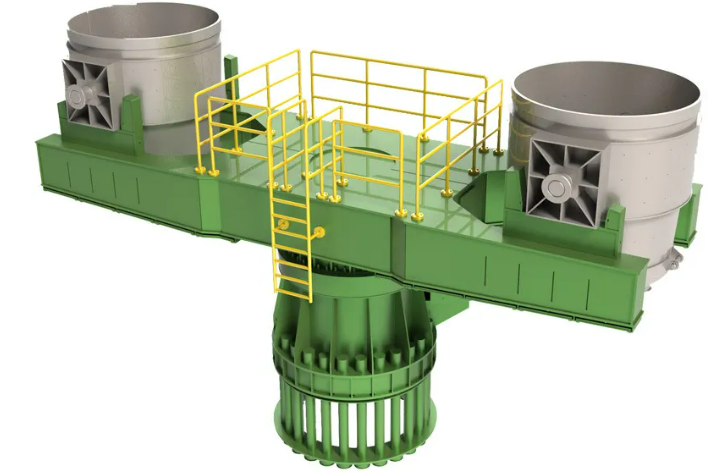
This artical focuses on the working principles and functions of various systems in the continuous casting workshop.
(I) Core Casting System
- Ladle and Tundish System
Ladle: Receives refined stainless steel molten steel, possesses precise flow control capabilities, and evenly supplies steel to the tundish through a long nozzle, ensuring the temperature and cleanliness of the molten steel.
Tundish: Buffers molten steel, stabilizes the flow field, promotes the flotation and purification of inclusions, and distributes molten steel to each crystallizer. During the production of 300 series stainless steel, its capacity is typically 20%~40% of the ladle’s capacity, requiring a dedicated slag-blocking wall and diversion sand.
- Crystallizer and Vibration System
Crystallizer: The “heart” of continuous casting, made of forced water-cooled copper, precisely shaping the cross-section of the square billet. It forms a 10-30mm initial billet shell through rapid heat conduction, resisting the static pressure of the molten steel.
Vibration Device: Drives the crystallizer to perform sinusoidal or non-sinusoidal periodic vibration, preventing billet shell adhesion and leakage, and forming a protective slag lubrication layer; 300 series stainless steel is suitable for high-frequency, small-amplitude vibration, with a frequency of 50-200 times/min and an amplitude of ±3~±4mm.
- Secondary Cooling System
Composition: Consists of a fan-shaped section (support rollers + spray manifold) and a water distribution system, with multi-segment precise controlled cooling.
Function: Accelerates billet solidification, controls uniform billet shell growth, and avoids bulging and internal cracks; 300 series stainless steel requires dynamic water distribution, adapted to the solidification characteristics of austenitic structures.
(II) Straightening and Cutting System
- Straightening Machine
Core Equipment: Multiple pairs of traction rollers + straightening rollers provide stable drawing power for straightening high-temperature billets (arc continuous casting machine).
Function: Continuously draws out the billet, eliminating bending stress and ensuring straightness; 300 series stainless steel requires a low plasticity range to avoid straightening cracks.
- Cutting Equipment
Type: Flame cutter (suitable for the high-temperature characteristics of stainless steel).
Function: Cuts the billet to a fixed length (6-12m), ensuring a smooth, burr-free cut.
(III) Auxiliary Systems
- Ingot Guide Rod System: The ingot guide rod matches the billet cross-section, sealing the bottom of the crystallizer during casting, solidifying with the molten steel to form a billet, and guiding the billet into the straightening machine.
- Lubrication and Protection System: Protective slag fills the gap between the crystallizer and the billet shell, providing lubrication, heat insulation, and adsorption of inclusions; 300 series stainless steel requires a special high-basicity, high-viscosity protective slag. 3. Detection and control system: including liquid level detector, temperature sensor, pressure sensor, and PLC control system to achieve real-time closed-loop control of parameters.