
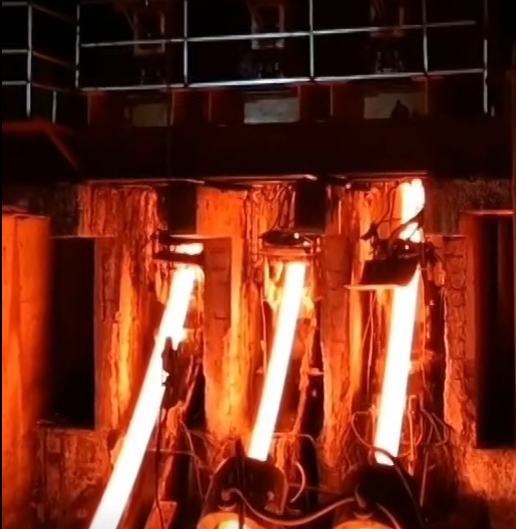
(I) Core Quality Control Indicators
- Surface Quality: No longitudinal cracks, transverse cracks, scratches, slag inclusions, excessively deep vibration marks, and rough surface.
- Internal Quality: No central segregation, porosity, internal cracks, or inclusions; density meets standards.
- Dimensional Accuracy: Cross-sectional dimensional deviation ≤ ±1mm, rhombic deformation (squareness) ≤ 3%, straightness meets standards.
(II) Full-Process Control Measures
- Steel Source Control – Refining Stage: Strictly control the composition of 300 series stainless steel (Cr and Ni precisely meet standards), reduce S and P content, strengthen inclusion removal, and improve steel cleanliness. Before Casting: After the steel arrives, measure the temperature and take samples to confirm that the superheat and composition meet standards; unqualified steel is strictly prohibited from being cast.
- Casting Process Control – Liquid Level Control: The liquid level in the crystallizer is stable, with fluctuations ≤ ±3mm. Slag entrapment is avoided through automatic control or precise manual adjustment. – Protective Slag Management: Replenish protective slag promptly to ensure a liquid slag layer thickness of 10-15mm, and regularly clean impurities from the slag layer. Equipment Status: Monitor the operating parameters of the crystallizer, secondary cooling system, and straightening equipment in real time; adjust or shut down for maintenance immediately if abnormalities occur.
- Post-Processing Control – Cutting: Ensure the cut is smooth, free of burrs and cracks; clean oxide scale promptly after cutting.Inspection: Inspect the surface quality of each piece; use ultrasonic testing for internal quality; isolate and scrap defective billets promptly. Stacking: Stack according to type, avoiding collisions and moisture to prevent surface corrosion.
(III) Typical Defect Prevention Plans
- Surface Longitudinal Cracks (Highly Occurs in 300 Series Stainless Steel) – Prevention: Optimize the crystallizer taper (to accommodate austenitic shrinkage), select specialized protective slag, stabilize the liquid level and casting speed, and strictly control superheat (15-25℃). 2. Center Segregation and Porosity – Prevention: Reduce superheat, stabilize casting speed, employ gentle reduction technology, and optimize the uniformity of secondary cooling water distribution.
- Inclusion Defects – Prevention: Enhance refining (calcium treatment compatible with 300 series stainless steel), optimize tundish slag-blocking design, increase the adsorption capacity of protective slag, and prevent secondary oxidation.
- Rhomboid Transformation (Square Removal) – Prevention: Employ single-taper/double-taper crystallizers, enhance corner cooling, precisely calibrate the arc alignment of the fan-shaped segments, and control cooling differences between adjacent surfaces.