
1 Raw Materials
Production primarily uses high-quality scrap steel and a small amount of pig iron, strictly controlling the total residual elements Cu, Ni, Cr, and Ti to ≤0.015%. High-quality lime, fluorite, and pre-melted refining slag are used as slag-forming agents. Deoxidation and alloying utilize silicon-manganese alloys, silicon-calcium alloys, and low-carbon ferromanganese to ensure controllable carbon increase and stable deoxidation.
2 Process Flow
A typical short-process route is adopted:
EAF electric arc furnace primary refining → LF ladle refining → VD vacuum degassing → CCM billet continuous casting → high-speed wire rod rolling → finished product inspection and warehousing.
The entire process is carried out in a closed and protected manner to minimize secondary oxidation and gas absorption.
3 Key Process Controls for Each Step
3.1 EAF Electric Arc Furnace Primary Refining Control
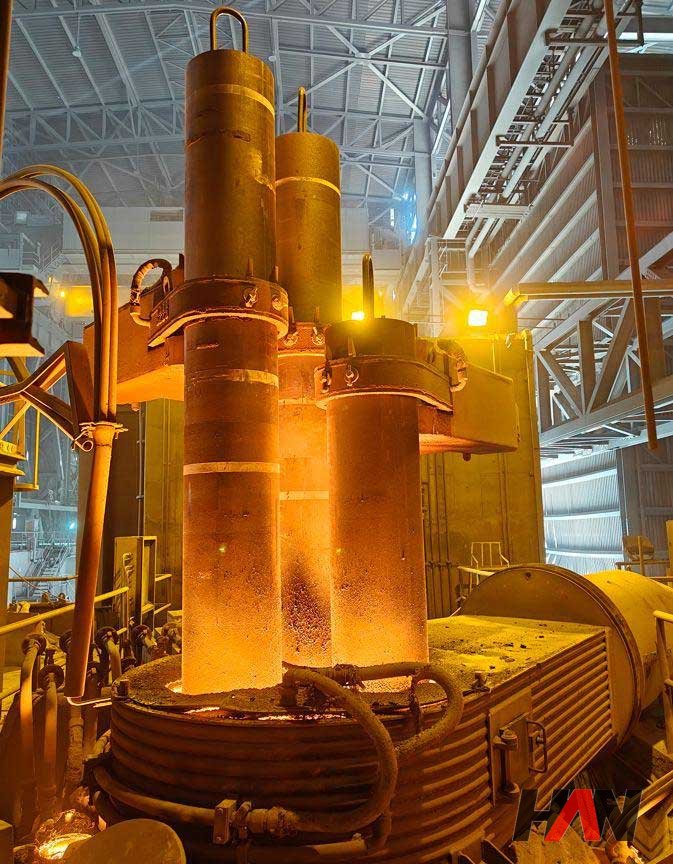
The EAF process focuses on achieving rapid melting, efficient dephosphorization, high-carbon steel tapping, and stable slag blocking, creating low-oxygen, low-phosphorus, and suitable initial conditions for refining.
Power supply is controlled in stages: high power during melting, appropriate oxygen supply for slag formation during oxidation, and prevention of over-oxidation at the final stage.
The final carbon content is controlled at 0.72%–0.82%, using high carbon steel to reduce deoxidation difficulty and inclusion formation.
The final phosphorus content is ≤0.012%, with a tapping temperature of 1620–1660 ℃.
Strict slag control is implemented during tapping to prevent slag from entering the ladle and causing sulfur and phosphorus reversion and secondary oxidation.
3.2 LF Refining Process Control
LF is the core process for desulfurization, deoxidation, composition fine-tuning, and inclusion modification in cord steel.
A high-basicity refining slag system is used, with a basicity R=3.5–4.5, maintaining white slag/carbide slag operation.
Deep desulfurization is achieved to S≤0.001%, with a minimum stable level below 0.0008%.
Composite deoxidation is used, controlling the acid-soluble aluminum content to avoid the formation of large amounts of brittle Al₂O₃.
Subsequent calcium treatment modifies high-melting-point inclusions into low-melting-point plastic inclusions, facilitating their flotation and removal.
Bottom-blowing argon stirring is performed throughout the process. Strong stirring in the early stages promotes desulfurization, while soft blowing in the later stages ensures uniform composition and temperature.
3.3 Vacuum Degassing Control
Vacuum degassing is mainly used for degassing, hydrogen reduction, and further removal of fine inclusions.
Vacuum degree ≤67 Pa, high vacuum maintained for 15–25 min, achieving deep dehydrogenation and denitrification.
After vacuum treatment, soft argon blowing for 12–20 min is performed, ideally with slight movement of the molten steel surface without exposure, promoting inclusion aggregation and flotation.
Control targets: [H]≤2×10⁻⁶, [N]≤25×10⁻⁶, T.O≤10×10⁻⁶.
3.4 CCM Continuous Casting Process Control
Continuous casting determines the surface and internal quality of the billet, with key controls focusing on segregation, porosity, cracks, and maintaining purity.
Full-process protective casting: Long nozzle argon sealing + submerged nozzle + special protective slag to prevent secondary oxidation.
Tundish superheat is strictly controlled at 15–25 °C; low superheat casting inhibits the rapid development of columnar crystals.
Electromagnetic stirring in the crystallizer + end-of-line gentle reduction technology significantly improves central carbon segregation.
Secondary cooling uses weak cooling and uniform water distribution, with a specific water volume of 0.6–0.8 L/kg, reducing surface and subsurface cracks.