
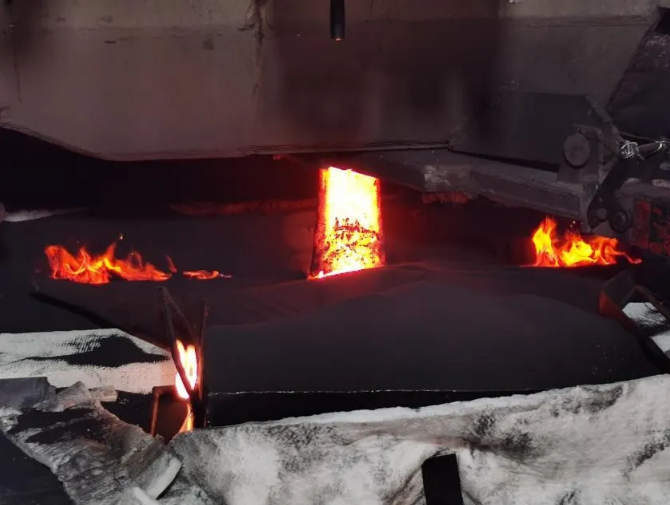
In the continuous casting process of steel, molten steel in the ladle is continuously injected into the crystallizer through the tundish nozzle. The molten steel is rapidly cooled by the inner wall of the crystallizer, forming a solidified shell of a certain thickness. This shell-laden billet is then continuously pulled out of the crystallizer by the dummy bar. The solidified shell acts as a container, maintaining the shape of the billet. After leaving the crystallizer, the billet enters the secondary cooling zone, where a secondary cooling mechanism sprays water or water mist onto the billet surface for secondary cooling, allowing the casting to solidify during its movement. Due to solidification, the molten steel in the crystallizer can adhere to the crystallizer, potentially causing the billet to break and resulting in leakage. To prevent this, a vibration device is installed on the crystallizer. During crystallizer manufacturing, to minimize the air gap between the billet and the crystallizer and maintain good heat transfer, a certain taper of the crystallizer must be considered. After solidification, the billet is cut into segments of a certain length by a cutting machine, thus enabling continuous pouring of molten steel from multiple ladles. The cooling zone of the billet is divided into three parts: The first part is cooling within the crystallizer. The molten steel injected into the crystallizer forms a shell of a certain thickness under its cooling effect, and the steel solidifies first within the crystallizer. The thickness of the shell formed by the solidification and heat dissipation of the molten steel in the crystallizer is affected by various factors (crystallizer taper, molten steel superheat, cooling water flow rate, flow field distribution, etc.). The stress generated by the combined effect of these factors directly affects the quality of the shell. The cooling and solidification of the molten steel in the crystallizer, the cooling and contraction of the shell, and the release of the latent heat of the molten steel create thermal stress in the solidified shell, which, due to stress concentration, induces cracks in the initial shell. The corners of the billet in the crystallizer cool fastest due to heat transfer in two directions, resulting in the greatest stress and a high frequency and severity of crack defects. The second part is cooling in the secondary cooling zone. The solidified shell of the billet exiting the crystallizer is very thin, with the molten steel in the center still in a liquid state. To prevent the solidified shell from breaking and causing molten steel leakage, the billet must be cut after it has completely solidified. The billet is further cooled in the secondary cooling zone, as shown in Figure 2. The secondary cooling system continuously cools the billet, allowing it to gradually solidify completely. Secondary cooling is a crucial component of continuous casting technology, significantly impacting the normal operation of the casting machine, ensuring output, and maintaining billet quality.
The third part is the air cooling zone. During solidification, a surface crystallization zone forms on the surface of the molten steel under cooling. As solidification progresses, columnar crystals are generated and grow in the direction opposite to heat transfer. After the columnar crystals grow, equiaxed crystals eventually form at their ends. During solidification, the formation of the billet's solidified structure is closely related to process parameters such as pouring temperature, casting speed, cooling conditions, and the nucleation density of supercooling. Changing the cooling conditions is fundamental to continuous casting process control. Heat loss and transfer during continuous casting always occur during the solidification of the molten steel. The main modes of heat transfer in continuous casting are convective heat transfer, conductive heat transfer, and radiative heat transfer. In the liquid phase, heat transfer occurs through conduction and convection within the molten steel. In the solid phase, heat transfer primarily occurs through conduction in the solidified billet. The billet solidifies exothermically within the crystallizer and secondary cooling zone as it moves along the casting direction.
Unlike ingot casting, in continuous casting, molten steel is continuously poured from the ladle into the crystallizer. The continuous billet is obtained through cooling in the crystallizer and secondary cooling zone, eliminating the need for initial billet preparation. Furthermore, forced cooling accelerates the cooling rate, resulting in a larger temperature gradient from the billet surface to its center. In addition, continuous casting offers advantages such as better billet quality, higher steel yield, shorter process flow, lower energy consumption, and higher production efficiency.