
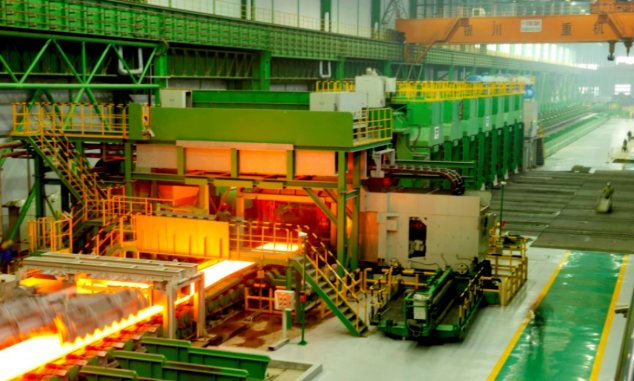
Thin slab (medium-thick slab) continuous casting and rolling is a rapidly developing hot-rolled strip production method since its practical application in 1990. What is its structure? We'll introduce it to you today:
By the end of 2005, nearly 40 thin (medium-thick) slab continuous casting and rolling production lines had been built worldwide. The main types include SMS's CSP, DEMAG's ISP, Sumitomo's QSP, DANIEL's FTSR, and Voestalpine's CONROL, etc.
Process Characteristics of Thin Slab Continuous Casting and Rolling
The slab thickness in thin slab continuous casting and rolling is 50-90mm. The continuous casting and rolling equipment often uses a tunnel-type hearth furnace connection. Its technological characteristics are as follows:
(1) 35-70mm thick slabs are selected for production based on different steel grades and required strip thicknesses;
(2) High cooling intensity in the crystallizer results in short columnar crystals and refined grain structure in the as-cast state;
(3) The roller hearth furnace allows for flexible control of the slab heating process;
(4) The use of a plate coil box reduces the temperature drop of intermediate slabs and shortens the distance between the pre-finishing mill and the finishing mill;
(5) The finishing mill uses a rolling speed similar to that of a regular finishing mill;
(6) A close-range underground coiler can be added for producing thinner strips;
(7) Suitable for producing thin-gauge strips.
Technical Characteristics of Continuous Casting and Rolling of Medium-Thick Slabs
The required slab thickness for continuous casting and rolling of medium-thick slabs is 100-150mm. A walking beam furnace is often used to connect the continuous casting and rolling equipment. Its technological characteristics are as follows:
(1) The production efficiency of continuous casting is well matched with the production rhythm of continuous rolling;
(2) It can handle significantly more flexible steel grades than thin slab continuous casting machines, providing greater flexibility in steel grades;
(3) There is no problem of insufficient compression ratio when producing thick strip steel;
(4) It is suitable for the transformation of traditional hot strip continuous rolling lines;
(5) It is suitable for improving strip quality and expanding product variety.