
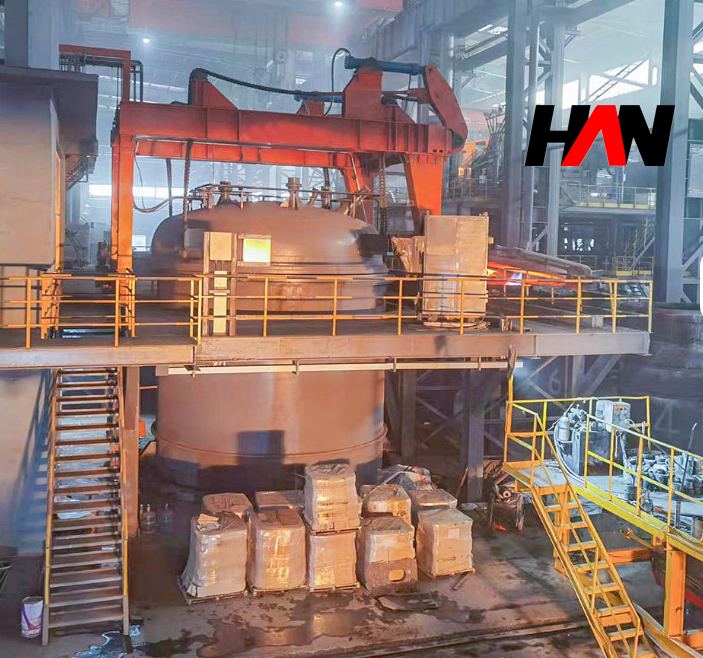
A vacuum degassing furnace is a complex piece of equipment composed of multiple subsystems that work together to ensure the smooth operation of the refining process.
1 Vacuum Chamber and Furnace Body
The vacuum chamber is a sealed container that creates a vacuum environment and is the main structural element of the entire equipment. A typical vacuum degassing furnace uses a movable or tilting water-cooled furnace cover design. After metal melting is completed in an atmospheric environment, the water-cooled furnace cover is moved to the top of the furnace body using a crane or a dedicated lifting device and sealed to form a sealed chamber. A heat-resistant sealing ring is used between the furnace cover and the furnace body to ensure high vacuum sealing. The furnace body itself can be a ladle containing molten steel or an induction melting furnace that integrates melting and containment.
Another common structural form is the vacuum ladle handling device, where a ladle containing molten steel is hoisted into a large vacuum tank, sealed, and then vacuumed. This type of vacuum tank can have a diameter of up to 5.8 meters and can handle 100 tons of molten steel.
2 Vacuum System
The vacuum system is the "heart" of the vacuum degassing furnace, responsible for rapid evacuation and maintaining the required vacuum level. A typical vacuum system employs a multi-stage pump configuration, including mechanical pumps, Roots pumps, oil diffusion pumps, or steam jet pumps.
Taking a large VD furnace as an example, its vacuum pump system operates according to a staged start-up logic: the primary pump (e.g., E5a, E4a) starts first at atmospheric pressure; once a certain vacuum level is reached (e.g., 40 kPa), the main evacuation pump starts; then, pump stages with higher vacuum levels are sequentially started at different pressure thresholds such as 10 kPa, 2 kPa, and 0.8 kPa. This staged start-up strategy ensures evacuation efficiency while avoiding damage to the pump body due to excessive pressure differentials.
Filters and condensers are also installed on the vacuum lines to capture impurities such as metal vapor and dust carried during the evacuation process, protecting the vacuum pump and reducing environmental pollution.
3 Heating and Stirring System
Heating System: In the induction melting vacuum degassing furnace (IMVD/VID), heating is achieved through induction coils. The induction coils are wound around the furnace body, and a medium-frequency or mains-frequency current is applied, generating eddy current heating in the metal material to melt it. This method integrates melting and heat preservation, simplifying the equipment structure.
Stirring System: Stirring is mainly achieved through two methods—bottom-blown argon stirring and electromagnetic stirring. Bottom-blown argon stirring involves blowing argon gas into the molten metal through permeable bricks installed at the bottom of the furnace or ladle, offering flexible operation and precise control. Electromagnetic stirring utilizes the interaction between induced current and a magnetic field to propel the molten metal flow, suitable for specific furnace types. In actual production, both methods can be used in combination to achieve the best stirring effect.
4 Auxiliary System
The auxiliary system includes a monitoring and control system, a cooling system, and a dust removal system. The monitoring and control system uses instruments such as vacuum gauges and thermocouples to monitor the vacuum level and temperature in real time, and a PLC or DCS system enables automatic control. The cooling system uses circulating water cooling to cool high-temperature components such as the furnace cover and vacuum pump, ensuring safe equipment operation. The dust removal system includes bag filters and cyclone separators to purify exhaust gases and meet environmental protection requirements.