
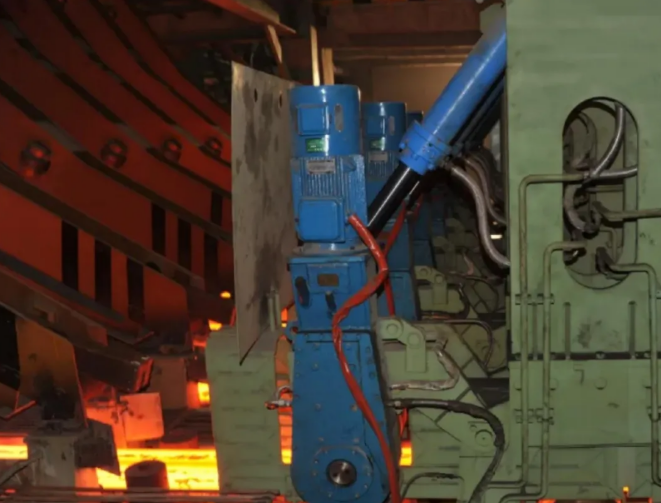
Pre-operation Confirmation
(I) Confirmation of the Casting System
- Ladle: Check that the lining is intact and free from corrosion, the long nozzles are well sealed, and it has been baked to above 1000℃ with no cold steel adhering to it.
- Tundish: The refractory lining has been baked to the correct temperature, the slag retaining wall and diversion sand are installed according to regulations, and there are no cracks or risks of steel leakage; 300 series stainless steel needs to be cleaned of residual slag to avoid contamination.
- Nozzle System: The centering deviation of the submersible nozzles should be ≤±1mm, the insertion depth should be controlled within 100-150mm, and there should be no blockages or damage.
(II) Confirmation of the Crystallizer and Vibration System
Crystallizer: The wear on the working surface of the copper plate should be ≤1.5mm, the taper should be adapted to the shrinkage characteristics of 300 series stainless steel (0.8-1.2%/m), the cooling water gap should be unobstructed, the flow rate should be stable (≥120m³/h), and the inlet and outlet water temperature difference should be 6.5-7.5℃. 2. Vibration Device: Amplitude and frequency calibration are accurate; vibration trajectory error ≤ 0.1mm; lubrication system is normal, with no jamming or abnormal noise.
(III) Secondary Cooling System Confirmation
- Fan-shaped Section: Roller gap and arc alignment are accurate; spray nozzles are not clogged or detached; water pressure and flow rate match 300 series stainless steel process (specific water flow rate 0.5-0.8L/kg).
- Water Distribution System: Water flow in each section is normal, with no leakage or water pressure fluctuations; water quality meets standards (no impurities).
(IV) Straightening and Cutting System Confirmation
- Straightening Machine: Traction rollers and straightening rollers have smooth surfaces free of foreign objects; pressure is stable; motor current is normal, with no jamming or slippage.
- Cutting Equipment: Cutting gun and pipelines are intact; gas and oxygen pressures are stable; cutting program preset is accurate. (V) Auxiliary System Confirmation
- Ingot Guide Rod: Surface free of deformation and cracks; matching degree with the crystallizer ≥98%; precise positioning of the pushing device (deviation ≤±1mm).
- Protective Slag: 300 series stainless steel special slag with physicochemical properties meeting standards (basicity 1.0-1.2); stored dry and free from moisture.
- Detection System: Liquid level, temperature, and pressure sensors are effectively calibrated; data transmission is stable in real time; alarm function is normal.
Common Production Problems and Solutions
(I) Crystallizer Related Problems
Adhesive Leakage - Causes: Mismatched protective slag performance, large liquid level fluctuations, severe copper plate wear, and excessively high superheat.
- Solutions: Replace with suitable 300 series stainless steel protective slag; stabilize the liquid level (fluctuation ≤±3mm); replace worn copper plates promptly; strictly control superheat (15-25℃).
- Excessively Deep Vibration Marks and Cracks - Causes: Vibration parameter mismatch; excessively high negative slip rate.
- Solutions: Optimize the vibration curve (non-sinusoidal mode), reduce the negative slip rate, and control the vibration mark depth to ≤0.3mm.
(II) Secondary Cooling Related Issues
Bulging and Internal Cracks - Causes: Insufficient secondary cooling water volume, excessive roller gap in the fan-shaped section, and misalignment of the arc.
- Solutions: Dynamically adjust the secondary cooling water distribution, calibrate the roller gap in the fan-shaped section (deviation ≤±0.5mm), and ensure precise arc alignment.
- Surface Scratches - Causes: Cold steel sticking to the rollers, abnormal operation, and billet deviation.
- Solutions: Clean foreign objects from the roller surface, repair the operating equipment, and adjust the guides to prevent deviation.
(III) Straightening and Cutting Related Issues
Straightening Cracks - Causes: Large fluctuations in drawing speed, and straightening temperature within the low plasticity range of 300-500℃.
- Solutions: Stabilize the drawing speed (fluctuation ≤±0.05m/min), avoid straightening in the low plasticity range, and optimize the straightening temperature curve. 2. Cutting Defects - Causes: Mismatched cutting parameters, insufficient fuel gas purity.
- Solutions: Adjust cutting oxygen pressure and speed, use high-purity fuel gas, and ensure a smooth, crack-free cut.