
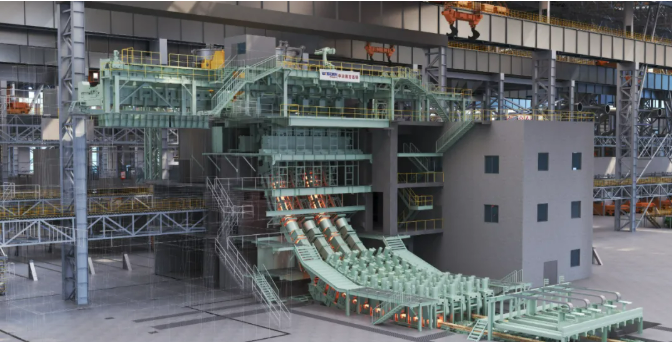
Differences between round billet continuous casting and square billet casting
I. Ellipticity Requirements: Square and rectangular billets do not have ellipticity issues. The leveling rolls are in surface contact, and the pressure of the leveling machine is generally controlled between 1.5 and 4 MPa. Even if the reduction in the inner and outer arc directions is large, it will not affect the rolling process. Round billets are different; they generally use a pressure of 0.5-1.5 MPa, mainly depending on the cross-section. If the cross-section increases, excessive pressure will cause ellipticity to exceed the standard. This is the biggest difference between square and round billet production.
Furthermore, because the leveling pressure is lower during round billet production, the friction generated is also relatively smaller, causing frequent gap vibrations in the cast billet. This can also affect the liquid level fluctuation in the crystallizer, thus creating some internal and external quality problems in the cast billet.
II. Surface Quality Requirements: Continuous casting of round billets has high requirements for surface quality, and the cast billet is prone to surface quality problems. The most common are localized depressions, cracks, and slag grooves. Generally, some quality problems in square billets can be eliminated through the rolling process. However, round billets are different. Defects visible to the naked eye must be manually repaired, including the removal of cutting nodules during flame cutting to minimize their impact on piercing and centering.
III. Requirements for Internal Cracks: Improper cooling control of square and rectangular billets easily leads to corner cracks, bulging, and de-squaring. Round billets are less prone to internal cracks. Cooling intensity at most affects the central porosity level, and internal cracks generally do not occur. Therefore, the design and configuration of the secondary cooling system differ from that of square billets.
IV. Requirements for Drawing Speed: Square and rectangular billets require secondary heating and rolling. Shrinkage cavities and segregation can be welded and mitigated through re-rolling, allowing for higher drawing speeds. Round billets, however, are directly supplied to seamless steel pipe mills for rolling. The internal shrinkage cavities and segregation of the cast billet have higher requirements, necessitating lower drawing speeds.
V. Process Parameter Requirements
- Casting Speed and Flow Rate: Appropriate casting speed mainly considers: First, ensuring the roundness of the billet requires controlling the billet straightening temperature to prevent excessive reduction in high-temperature billets; second, the casting speed must be matched with the furnace and casting machine. For continuous casting machines producing high-quality round billets, a lower casting speed process must be implemented. The casting speed for producing Φ330mm round billets is set at ≤0.8m/min, and the main casting speed is controlled at 0.6m/min to meet the furnace and casting machine rhythm.
- Tundish Pouring: High liquid level pouring should be implemented as much as possible. A higher liquid level, a larger volume of molten steel, and a carbon-free covering agent for protection during the entire casting process are all effective means of controlling billet quality.
- Secondary Cooling Requirements: To achieve uniform cooling, an air mist cooling mode must be used. The nozzles should be staggered around the billet for complete coverage.
- Pouring Temperature Requirements: For high-Mn, high-Al steel grades such as Q345E, core cracks have occurred in the early stages, all of which were in the first casting batch, indicating relatively high overheating during pouring. First, this type of steel has a relatively high aluminum content, resulting in poor molten steel fluidity. To avoid tundish nozzle blockage, the superheat of the molten steel in the casting furnace is controlled at a high level. Second, high superheat inevitably necessitates low-speed casting. When the secondary cooling water ratio is mismatched, a significant temperature difference exists between the billet surface and the core, leading to core cracks under thermal stress.
VI. Other Supporting Equipment
1: Built-in electromagnetic stirrer;
2: All-stainless steel crystallizer assembly;
3: High-precision crystallizer inner water jacket;
4: High-precision pneumatic diaphragm valve for controlling water flow;
5: Non-sinusoidal vibration process;
6: Staggered spray system in the secondary cooling zone.
Continuously cast round billets are mainly used to produce seamless steel pipes, ring forgings and forged gear blanks, flanges, anchor chains, and other mechanical parts.
Our main product range includes: High-quality carbon structural steel: 20, 45, 20G, CL60; Alloy structural steel: 15~45C, 20CMInTI; 25MNG, 20MnG, 37Mn5, ASTMA105, etc.; Anchor chain steel: AM2, AM3; Bearing steel: GCr15; Low-alloy high-strength structural steel: 16Mn, etc.