
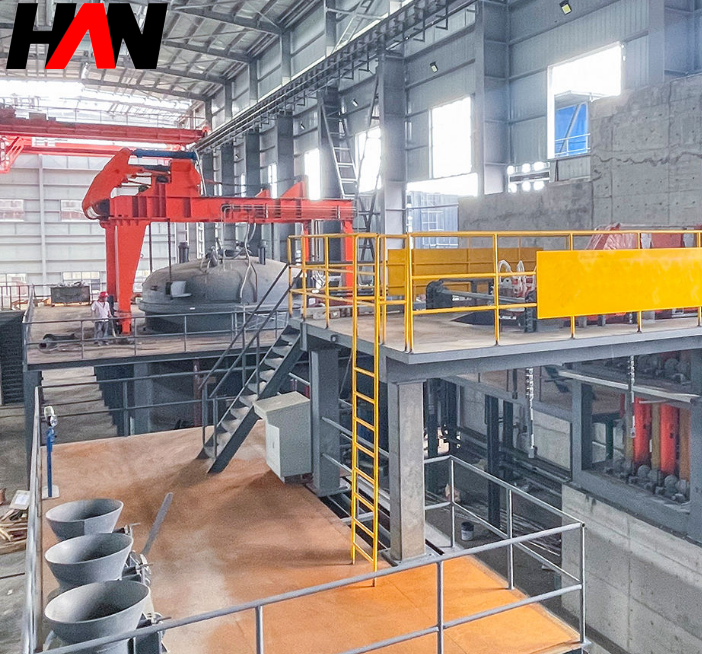
Working Principle: Gas Removal Mechanism Based on Partial Pressure Difference
The working principle of the vacuum degassing furnace is based on fundamental laws of physics, with its core being gas diffusion and desorption driven by partial pressure difference.
Under normal pressure, gas molecules have a certain solubility in liquid metal. When molten metal is placed in a sealed container and evacuated to a high vacuum, the gas pressure inside the container drops sharply. According to Siward's law, the solubility of a gas in a metal is proportional to the square root of its partial pressure. When the gas phase pressure above the molten metal decreases, hydrogen, nitrogen, and other gas molecules originally dissolved in the molten metal will automatically diffuse into the gas phase due to their partial pressure being much higher than the ambient pressure, forming bubbles that rise and escape, ultimately being removed by the vacuum system.
In addition to purely physical degassing, the vacuum environment also promotes chemical deoxygenation. Under vacuum conditions, the deoxygenation capacity of carbon is significantly enhanced, allowing the reaction C + O → CO↑ to proceed fully. The generated CO bubbles, during their ascent, not only carry away oxygen but also entrain some non-metallic inclusions, achieving a combined purification effect. This reaction is widely used in large-scale VD furnaces, reducing [H] in the molten steel to below 2 ppm and [N] to below 80 ppm after treatment.
To further improve degassing efficiency and compositional uniformity, modern vacuum degassing furnaces are generally equipped with stirring systems. The most common method is to blow argon gas into the permeable bricks at the bottom of the ladle. The rising tiny argon bubbles create a "bubble pump" effect in the molten metal, greatly increasing the gas-liquid contact area and accelerating gas diffusion; on the other hand, it promotes circulation in the molten metal, making the temperature and composition more uniform. Some equipment also uses electromagnetic stirring technology, using an industrial frequency induction coil to generate electromagnetic force to drive the flow of molten metal, achieving a homogenization effect.